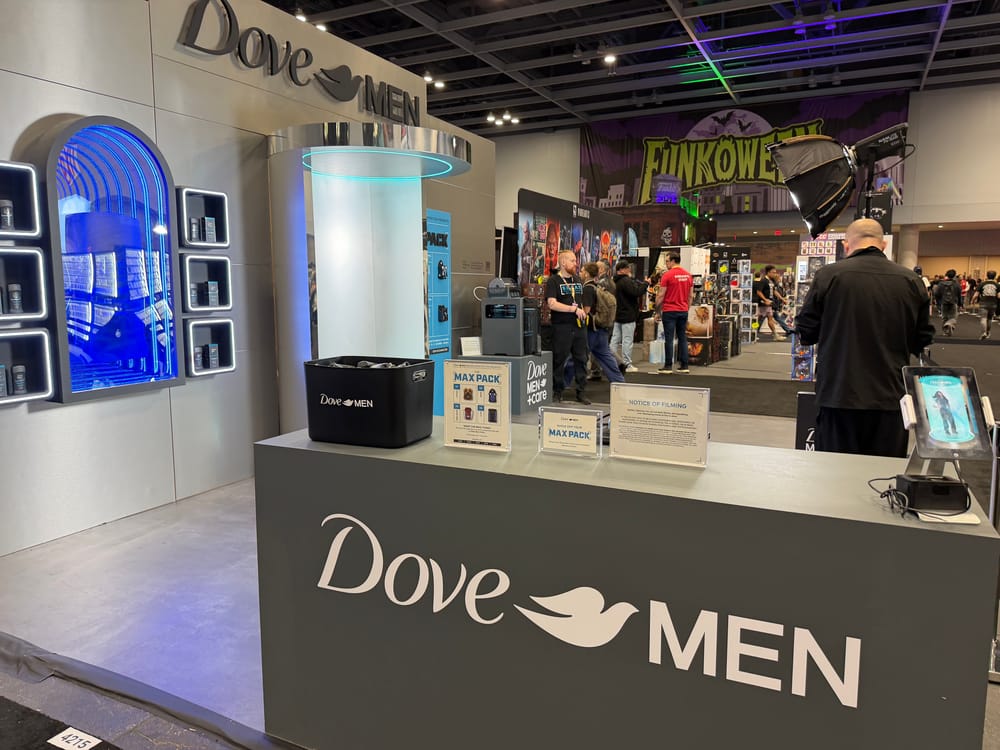
Convention halls like the Javits Center during New York Comic Con are intense, sensory-heavy environments. Across four days, roughly 250,000 fans gather to celebrate pop culture, moving through spaces dominated by major entertainment franchises-from Peacock’s Camp Crystal Lake activation to Paramount Games’ massive crocheted Appa display. But amid the spectacle of upcoming releases and Hollywood IP, an unexpected category has carved out a distinct presence: personal care.
Mainstream, non-endemic brands have steadily filtered into fan conventions since Comic Con passed the 100,000-attendee mark in 2011, paving the way for retail and tech giants like Walmart, eBay, and Duolingo. Yet entering fan spaces requires caution. As Lindsey Lapin, associate director of marketing for Dove Men+Care at Unilever, pointed out, men’s passions and hobbies have diversified significantly, but few men spend their mental energy obsessing over grooming products. They spend that energy on their fandoms. The marketing challenge is not simply reaching that audience, but finding a legitimate reason to share their space.
Dove Men+Care answered that challenge by looking at the physical reality of fandom. Cosplay is an art form that demands months of craftsmanship, heavy fabric layering, and hours on crowded show floors. The inevitable result is heat and sweat. Rather than treating Comic Con as an indiscriminate sampling drop, the brand framed its high-performance antiperspirant as a practical solution to a known convention struggle. Partnering with cosplay creators including Andrew McLean, Gideon, Con Culture, and Frank, the brand integrated its product directly into the costuming and prep routine.
To deepen the community connection, Dove teamed up with 3D-printing specialist Galactic Armory to produce 1,000 custom Max Packs-utility cases designed to carry personal essentials without clashing with intricate costumes. Backed by digital out-of-home placements and 30,000 sample distributions, the activation drove 3.1 million impressions and six earned media placements. Crucially, the objective centered on cultural salience rather than immediate transactional attribution.
Subcultures possess sensitive immune systems when it comes to outside corporate interest. When enthusiasts invest weeks of labor into creative self-expression, generic brand posturing falls flat. The lesson here is simple: brands do not win over passionate communities by asking for attention, but by reducing friction in their experience. When an audience wonders why an everyday brand took so long to solve an obvious problem, the marketing has quietly succeeded.