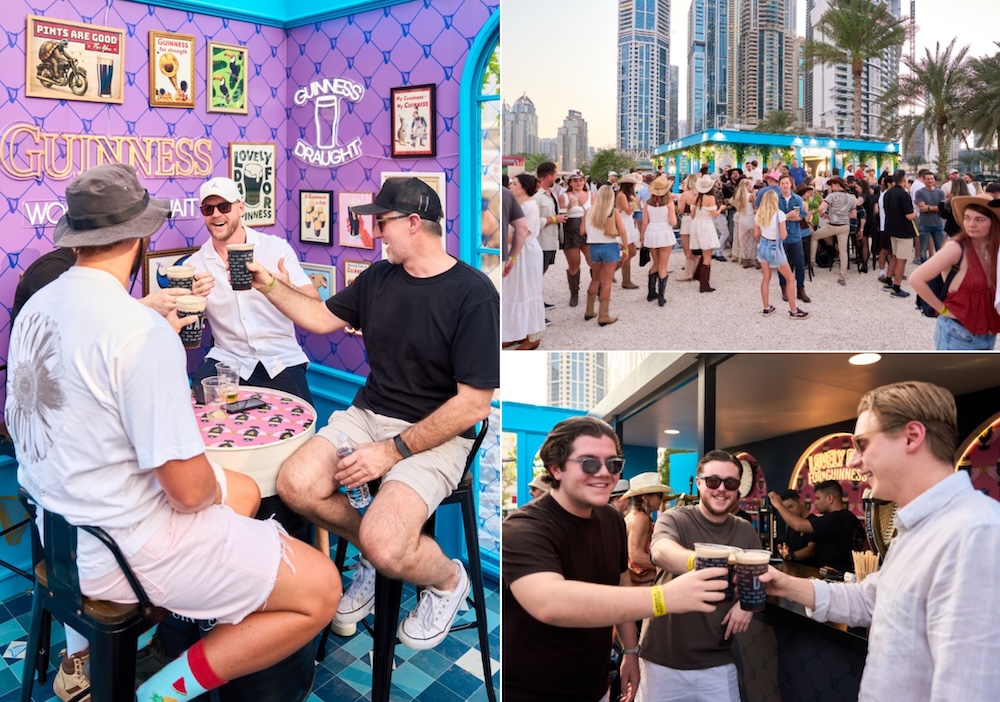
Every heritage brand eventually confronts the boundaries of its own iconography. For Guinness, that historical anchor has long been the dark, moody pub, chilly weather, and a distinctly older male drinker. But what happens when you take an iconic, heavy Irish stout and attempt to position it under the blazing heat of the Middle Eastern sun?
Diageo and creative agency Those That Do took on this strategic tension by adapting the global platform ‘Lovely Day for a Guinness’ for the UAE through an experiential concept: The Thirsty Toucan, billed as Dubai’s smallest pub. The activation pulls the stout out of its familiar tavern backdrop and drops it straight into the outdoor festival calendar.
Rather than diluting the brand to assimilate into generic festival culture, the team doubled down on Guinness’s most distinctive brand assets, reinterpreting them for a warmer climate. The traditional black and gold color scheme received a neon treatment, the mid-century toucan mascot took center stage, and the compact footprint was energized with surprise Irish pop-up performances and conversation-starting card games.
For marketers, the activation offers a practical lesson in occasion expansion. Changing how consumers view a product requires more than clever messaging; it requires physical permission and contextual relevance. As Grace Murphy, Head of Beer for EEME at Guinness, explained, the brief was simply to bring the brand out of the dark and into the light. Guinness wanted to dismantle the assumption that stout is strictly a heavy winter drink by demonstrating that it can thrive in bright, casual social spaces.
The pop-up has already moved through events ranging from Taste of Dubai to the dog festival Woofstock, with future stops planned for pizza festival Slice DXB and music festivals. The commercial proof arrived quickly: The Thirsty Toucan drove a 900 percent year-on-year sales increase at Taste of Dubai.
Much of that traction came down to product integrity. Ginny Jackson, General Manager at Those That Do, emphasized that experiential concepts cannot afford to neglect product ritual. ‘Every pint is poured properly and served to the standard you would expect in Dublin, because the pint is the brand,’ Jackson noted. ‘Get that right, and you give people a reason to stay, to purchase, to engage and to enjoy the moment, rather than grabbing a drink and moving on.’
When global campaigns enter new territories, brands frequently make the mistake of over-accommodating local norms until their identity disappears. The smarter move is often to hold firm on brand ritual while altering the context. When done with confidence, the clash between a brand’s heritage and a new setting creates the exact curiosity needed to win over a new audience.