For years, legacy retail marketing has operated on a predictable rhythm: craft a polished campaign, buy reach, and protect the brand identity at all costs. But culture rarely moves in straight, corporate lines. More often, it gathers momentum in the messy, comedic corners of social feeds, waiting to see if anyone in authority is paying attention.
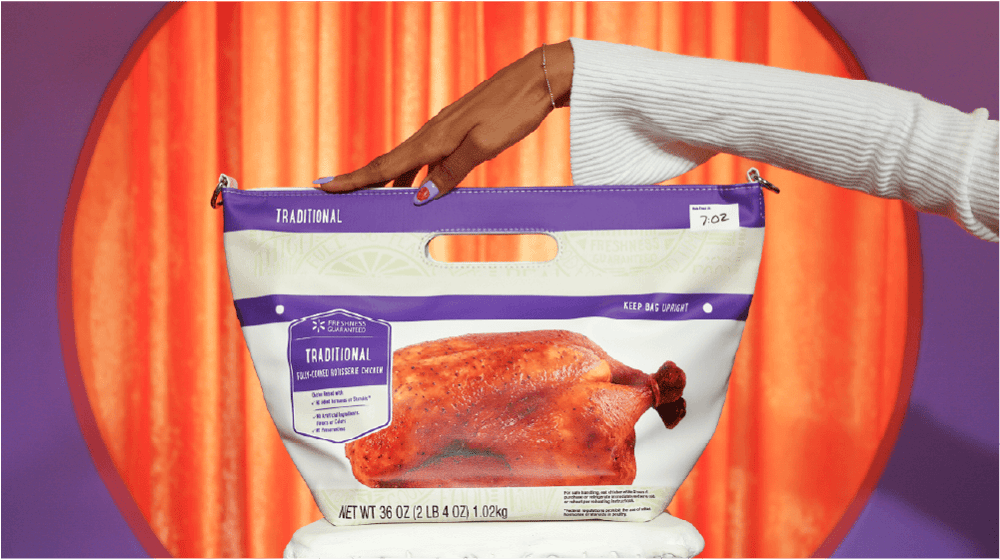
Walmart found itself in that exact position when its social listening team noticed an odd pattern. Its rotisserie chicken had quietly amassed an organic fandom, generating over 15,000 mentions. More specifically, shoppers were posting photos holding the plastic grease-lined chicken bag by its handle, joking that it was their luxury purse. Many brands would have chuckled in an internal Slack channel and moved on. Instead, Walmart did something modern retail rarely pulls off cleanly: it took the joke seriously without taking itself too seriously.
As Kim Tunick, Walmart’s group director and head of brand experiences and partnerships, explained, the social team brought the insight directly to merchandising. The proposition was simple: what if we actually made the bag? The team worked with production partners to replicate the exact dimensions and graphic packaging of the traditional and lemon-pepper chicken containers, adding a durable fabric build and a proper carrying strap.
The execution was remarkably sharp on brand fundamentals. The retailer priced the novelty tote at $5.97, the exact price of an actual rotisserie chicken, anchoring the product in instant recognizability. To engineer exclusivity, Walmart released an initial batch of 5,000 units, teasing the drop across owned channels and targeted influencer seeding. When the product went live on September 1, it sold out online in 90 minutes. At Walmart’s Bentonville campus store, eager shoppers lined up before 7 a.m. to purchase one, alongside matching charms shaped like hot sauce bottles and seasoning containers.
To deepen the narrative, Walmart transformed its physical Spark Shop with ambient orange lighting and glowing warmers, mimicking an actual rotisserie display to prompt customer-generated content. Secondary markets soon confirmed the appetite, with bags reselling on eBay at more than seven times their original retail value. A second run saw even higher demand.
There is an essential lesson here for marketers navigating an era of fragmented consumer loyalty. Social listening is too often relegated to sentiment tracking, brand safety, or crisis mitigation. Walmart treated it as an engine for consumer-led product incubation. By listening closely and allowing its audience to write the creative brief, the retailer bridged the gap between everyday utility and cultural resonance.